
How to store firewood so it stays dry
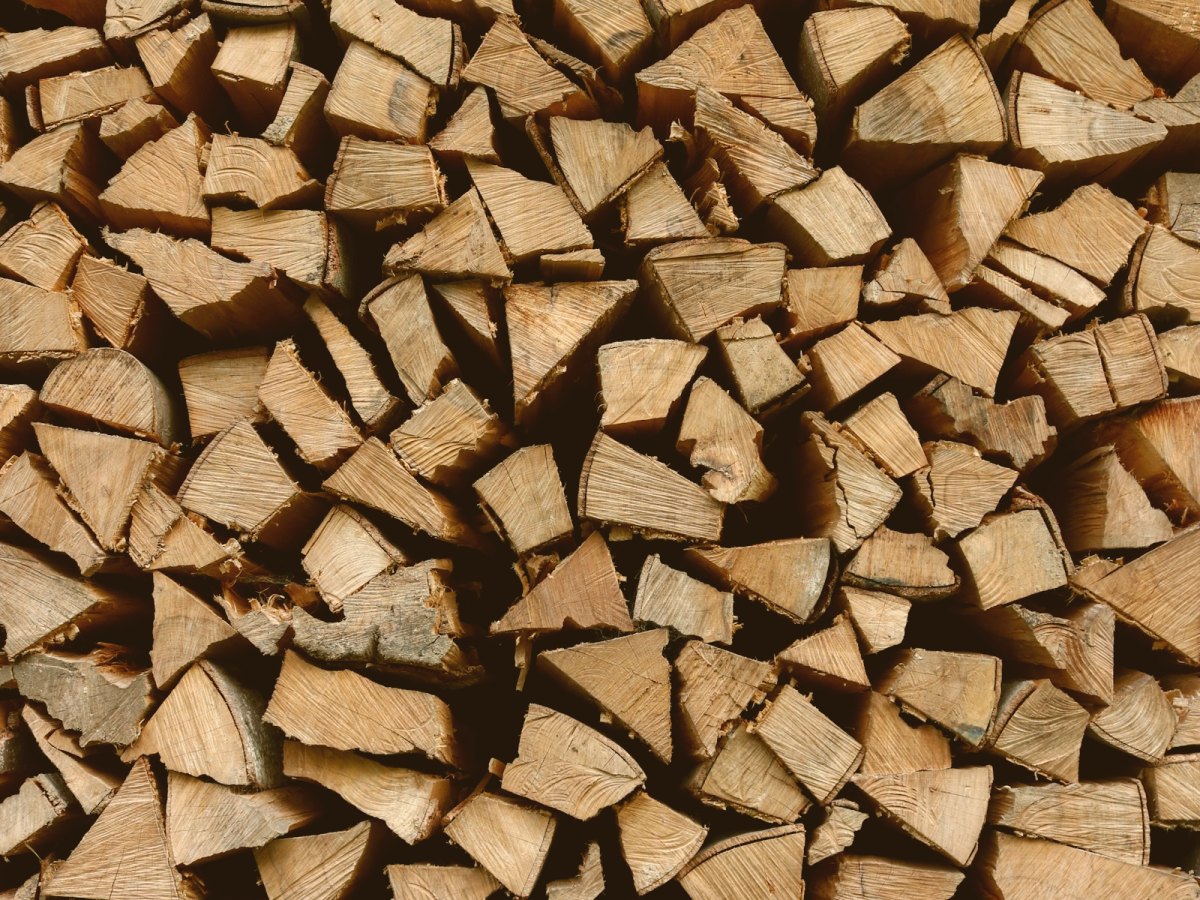
To keep firewood dry, store it under a roof but with open or slatted sides, raised off the ground and stacked so that air moves freely between the logs. The key rule: cover the top against rain and snow, leave the sides open — firewood is dried by moving air, not by warmth.
We produce our firewood ourselves in Latvia and deliver it in Riga and the surrounding area. Here is how to stack it, where to keep it and how to tell it is ready to burn.
Why firewood must be dry
Fresh wood contains a lot of water. When you burn it, much of the heat goes into boiling that water off: the stove warms up poorly, there is more smoke and soot, and the chimney clogs faster. As a general rule, firewood should have a moisture content of no more than about 20 %. Split logs dry much faster than whole rounds. In good conditions split firewood usually needs at least one warm season, denser wood longer.
Woodshed or covered stack
Woodshed
The best option for long-term storage. It needs a solid roof with a small overhang and sides of spaced boards or a lattice, so the wind carries moisture away. A sunny, breezy spot is best. You can build one yourself from fresh-sawn boards and beams.
Covered stack outdoors
Without a shed, stack the logs and cover only the top — with roofing sheets, boards or a heavy tarpaulin that hangs just slightly over the edges. If you wrap the whole stack in plastic, condensation forms underneath and the wood goes mouldy instead of drying.
How to stack firewood
- Off the ground. Put pallets, beams or boards underneath so the wood does not draw moisture from the soil and air can pass below.
- Away from the wall. Do not push the stack tight against a house or shed wall — leave at least a hand-width gap for air.
- Loose and shallow. A row one or two logs deep dries better than a wide, dense pile. Leave a small gap between rows.
- Ends open. Most moisture leaves through the log ends, so keep them exposed to the wind.
- Top row bark up. Rainwater then runs off more easily.
How much space does 1 m³ of firewood need
Firewood is sold by the loose cubic metre or the stacked cubic metre. A loose m³ is logs thrown freely into a 1 m³ volume; a stacked m³ is logs neatly stacked 1×1×1 m. When stacked, the same firewood takes up roughly two thirds of its loose volume (depending on log length and shape). To work out the length of a stack, divide the stacked volume by the stack height and the log length. For example, with 30 cm logs and a 1 m high stack, one stacked m³ needs about 3.3 m of stack length. More about units and comparing prices: firewood price in Riga and how to choose.
How much to bring indoors
Bring in only a few days' supply. Large amounts indoors can bring in insects and mould, and logs must never sit right next to a stove — keep the manufacturer's safe distance.
Signs of dry firewood
- The log feels noticeably lighter than a fresh one.
- The ends show cracks and the wood has turned greyish.
- Two logs knocked together give a clear ring, not a dull thud.
- A moisture meter gives the exact figure (measure a freshly split face).
Common mistakes
- Logs dumped in a heap on the ground and left in the rain.
- The whole stack wrapped in plastic, trapping condensation.
- Wood kept in a closed, unventilated cellar or garage.
- The stack pressed tight against the house wall.
- Unsplit rounds left to dry — they take far longer.
How to order firewood with delivery in Riga
Choose the wood type and quantity on the split firewood (birch, alder, hardwood) page — the price is shown in the calculator straight away. See the whole range under split firewood. Delivery is priced by distance as soon as you enter your address (delivery), or collect free of charge from our warehouse at Vējstūru iela 3, Riga. Ask about the moisture and log length of the current batch on +371 29568256. More tips in useful articles.
FAQ
Can I store firewood under plastic?
Only cover the top of the stack. If you wrap it completely, moisture stays inside and the wood goes mouldy.
How long does split firewood take to dry?
It depends on the species, log size and location. In a well-ventilated spot it usually needs at least one warm season, dense wood longer.
Can firewood be kept in a cellar?
Only if the cellar is dry and ventilated and the wood is already dry. In a damp cellar it moulds rather than dries.
How far from the house wall should I stack firewood?
Leave at least a small gap for air so both the wall and the wood stay dry. Near a stove, keep the safe distance.